Monday, December 2, 2013

Sumblog 12

What's Green Got To Do With It?

As we discussed in class, Greenpeace is a non-state political organization, which reinforces the trend we have been writing about for months; the world's organizations are moving from a national to a global stage. Using Greenpeace as an example, it is comprised of members from all over the planet and does not have an affiliation with any particular state. An example of an organization on the  national stage would be the National Wildlife Federation, with a strong association to the United States and members affiliated to their states. The middle ground between these two sides, which we are seeing more and more of as we transition, would be the United Nations where the organization operates on the global stage but its members maintain their state affiliation.

This trend can be seen in this graph depicting the amount of NGOs (non-governmental organization) created each year (the bars) and the total number of NGOs. As time passed before 1966, there were not many NGOs in existence or being created, but once 1966 came around there was a boom in the creation of NGOs. Since that date, the number has been rising and furthering the trend.
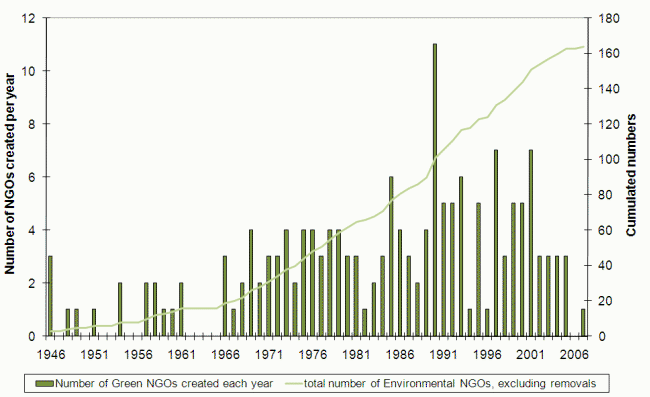
 
My opinion of this trend is positive. I feel that as more non-governmental global organizations are created, the world issues will begin to see more exposure and reactions. My once concern is that organizations operating on the national stage will lose power and the power of the world will become too central for dealing with domestic and local issues.

Monday, November 25, 2013

Sumblog 11

One of These Things is Not Like the Other

On the topic of development in Kenya, where the global system is in direct conflict with the local population, the term cultural imperialism has a large role. In this case, cultural imperialism refers to the global influence of the west on the development of other "less developed" areas of the world. Assuming that there is more than one way to develop, this could mean that as one area is taking its own path towards development, the global model of development (which is a mostly western version of development) is being imposed on that country, altering its course. We can see an example of this in the film we have recently viewed in class, where the views of what it means to be poor differs between a Kenyan family and an international farming company. The company had built a new rice farming installation in Kenya which they claimed was bringing needed development into this poor region of Kenya, however, it destroyed some of the livelihoods of these "poor" families. When you look at this from the Kenyan families' perspectives, they are not poor at all. A few of these families were quite rich in terms of livestock and land, which had just been destroyed by the company. The international company saw houses insulated with mud and struggling farmers, where in actuality, there were happy prosperous farmers.


What could be seen as poverty by our definition, could be seen as prosperity by another


I chose the picture (left) to demonstrate that what we see as a lack of wealth (houses made of sticks and tattered novels), could be interpreted differently by other cultures. I see this issue as something difficult to solve. I see the solution as education emphasizing the understanding of other cultures and their perspectives instead of considering only the western ideals. Like many solutions requiring more education, this goal would be almost impossible to achieve on a large scale, however, most of those making decisions with international impact are well educated and a change to the educational system would benefit the globe through its future leaders.

Monday, November 18, 2013

Sumblog 10

What ain't no country I've ever heard of!

Recently, the topic of population came into discussion while talking about the environmental facet of Globalization. There are many different ways of controlling population falling under two main categories: Population Control (pertaining to the births/potential births) and immigration control.

Visual depictions of the effects of China's one child policy.
I chose these three charts in order to demonstrate the effects of
population control on a country's pop. growth and demographics


Population control focuses on preventing or even limiting births through voluntary and involuntary methods. Voluntary methods include the promotion of birth control and other forms of family planning. Involuntary methods include sterilization (linked to necessary government aid) and laws only allowing each family to have one child.

Immigration control attempts to limit or restrict the number of people that move across borders and settle down. Some countries create large legal barriers to live, work and act within their borders without citizenship status, while others physically deport immigrants or physically protect their borders.

My take on the issue of population control is that as effective as some government's actions on pop. control may be, countries have often regulated their pop. through social and structural means (i.e. as more people move to the cities, children become less productive, as they were in rural areas, and more of a liability. This often has led to declining fertility). As times and environments change for a country, so should the population. Also birth and immigration policies tend to be very difficult to enforce in my opinion. While it may be hard for a non-citizen to find legitimate work, they may have a very easy time finding illegitimate, unregulated work.

Monday, November 11, 2013

Sumblog 9

A Better Brand of Berger Makes a Nation-State Stronger

In class, we discussed Berger's argument that the strongest cultures have a balance between fundamentalism and relativism. Both fundamentalism and relativism are ideal types, which no culture can be entirely one or the other. That would be impossible! If a culture was entirely fundamental, there would actually be no fundamentalism; without new and changing ideals, the resistance against them (fundamentalism) would not exist. If a culture was completely relativist, there would be no guidelines or ideas of right and wrong. There would be a massive feeling of anomie throughout the culture. This brings it back to Berger's argument; a strong culture is a mix/balance of these two extremes. The culture would exhibit relativism by accepting new, changing ideas and showing tolerance towards the non-traditional. For example, the existence of the sign below, is a testament to America's relativism. It reinforces the relativist idea that a belief in God is not the only way to live, it is not an immutable truth.


Fundamentalism would be exhibited by maintaining a set of morals and rules that are held as truths (i.e. our systems of laws; instead of looking at each crime case by case, we have set truths which become our laws). An example of this is depicted in the image below. The idea that "There can be only one!" is itself fundamentalism, because the "one" is seen as the only truth/option.


I agree completely with this model/idea of a strong culture. If our country was more fundamentalist, there wouldn't be as many different sects of religion present and accepted as we have today. There could even be only one religion accepted and every other idea practiced would be prosecuted. On the other side of the coin, if America was more relativist, we might not have judicial system. If someone was to commit murder, we might see it as his/her own version of what one can and can't do, instead of deeming it right or wrong.

Monday, November 4, 2013

Sumblog 8

It's a Series of Tubes!

A large portion of this week's lecture/discussion has been the film on Anonymous and other sects branching off of it. Anonymous is a group of people (most of them with vast amounts of computer hacking and programming skills) who had found their shared values, beliefs, etc. in posts on an online forum called 4chan. Through this outlet, they became a globalized culture with their own symbols and language. The group's dynamics were always changing as time went on and the "membership" started to widen even into the domain of activism. Eventually those in the globalized community began to diverge slightly, based on their ideas and values, and formed sub-cultures within the Anonymous/4chan culture. One example of this was Lulzsec; a group with a stronger inclination towards chaos and trying to shake the powers that be.

When you look at how this community formed, it appears to be the definition of culture; It formed solely on the basis of shared values, beliefs and symbols. Anonymous not only shares a huge value placed on freedom of speech and information, but they also share symbols, known as memes (see below), as well as a language (the ridiculously vast amount of Internet slang). Anonymous/4chan also develops over time and takes on different forms based on these developments, whether it is producing a new sub-culture within itself, or shifting from merely pranking to legitimate forms of activism. In my opinion, I would say that Anonymous/4chan is almost an even better example of pure culture than most nation-states.

Top Ten Memes
I choose this somewhat small list of memes in an attempt to recognize that although they are not the kinds of symbols we associate with cultural symbols (I.e. a flag), they are still symbols with a shared meaning for a vast amount of people.

Monday, October 28, 2013

Sumblog 7

They're Teaching Her. . . and Then They're Going to Teach Me! 

Our form of American mass public education is beginning to spread worldwide. Before we had public schools and classrooms where most of the educating took place, there were parents, master crafts-people, other more informal ways or learning. From there we began to educate children in a classroom setting and then we began to require education for everyone. That has become our form of education and it is becoming (if not, it already has become) the standard of education world wide.

For example, the NY Times Article, linked here, explains a push by the UN to provide classrooms and primary education for all children. The mass-education model is beginning to take the place of all other forms of education.

My internal feelings are that diversity is better for the world, meaning that nation-states should have their own forms of education, fitted to the needs of the nation-state. Some may need a larger focus on vocational training for factory and craftsman positions as opposed to learning about topic above the practical needs of the country. On the other side of the coin, my realistic feelings point towards conforming to the global standard of education. I think it's very important in today's global conditions to conform to what the world is considering "developed", if a nation-state does not, they might be left slowly developing while the rest of the world grows at a much faster rate.

A compromise between the two sides of the issue could be to slightly tailor the mass-education model to each nation-state's needs. Some nation-states could educate all of their youth on the secrets of the physical world, while others could focus on building and maintaining small engines or electronics.


Sunday, October 20, 2013

Sumblog 6

Make a Nation-State out of Me

This idea of the world-identity, to me, could have some quite interesting consequences. First off, what I drew from our discussion in class is that there is a global identity which acts as a template for all nation-states, old and new. It acts as a mold for new developing nation-states, by guiding the development of said nation-state into the global model of what a nation-state would be. For example, a newly recognized nation-state is pushed towards the global identity's ideal of a developed nation-state (democratic, protective policies, environmental protection, etc.). The global identity can also pressure developed nations into conforming with the global model's values. An example of this can be seen in our own nation-state; although most other "developed countries" have some form universal healthcare coverage, we still have privatized insurance companies providing the majority of the coverage. We are moving towards universal healthcare (as slow going as it is) and will then fit into the global model of developed.

In my opinion, this idea is both beneficial and harmful. Sadly, if new developing nation-states are all developing in line with one model, global diversity of forms of government, policy, etc. will begin to decrease. Problems that re-occur will be solved using the same means, as opposed to using a possibly more efficient solution. 
This image (taken from Pink Floyd's The Wall) depicts my issue with the global identity, nation-states are molded by the global identity into a homogenous, ground beef-like "product".
On the other side of the coin, developing in different ways leaves a lot of room for mistakes and less humanitarian options. Nation-states may develop and have absolutely no environmental regulations or use practices that have been deemed inhumane (i.e. slavery). The developmental process would also take a lot longer without a global model to guide it.